Yacht Cost in Palma, Mallorca: Annual Ownership Expenses (2026)
A 100ft motor yacht based in Palma costs approximately $3,246,275/year to operate — or $270522/month. This is based on local marina rates of $110/ft/month and diesel at $7.0/gallon. The estimate covers crew, maintenance, insurance, fuel, dockage, and operating expenses. Use the calculator below to get a personalised figure for your vessel.
Annual Cost Breakdown: 100ft Motor Yacht in Palma
The following breakdown is based on a 100ft motor yacht valued at approximately $15 million, operating year-round in Palma with 200 engine hours annually and a crew of 6–7.
| Cost Category | Annual Amount | Key Driver |
|---|---|---|
| Crew salaries & benefits | $790,625 | Captain + 5–6 crew + chef |
| Maintenance & repairs | $1,690,000 | 11% of vessel value |
| Insurance (worldwide) | $315,000 | 1.5% × 1.4 range multiplier |
| Dockage (12 months) | $132,000 | $110/ft/month in Palma |
| Fuel (200 engine hours) | $104,649 | 65 GPH × $7.0/gal incl. generator |
| Provisioning & supplies | $150,000 | 60 cruising days, full crew |
| Management, comms & legal | $189,000 | Management, sat comms, registration |
| Total annual operating cost | $2,824,259 – $3,668,290 | 21.6% of vessel value |
Marina Rates in Palma
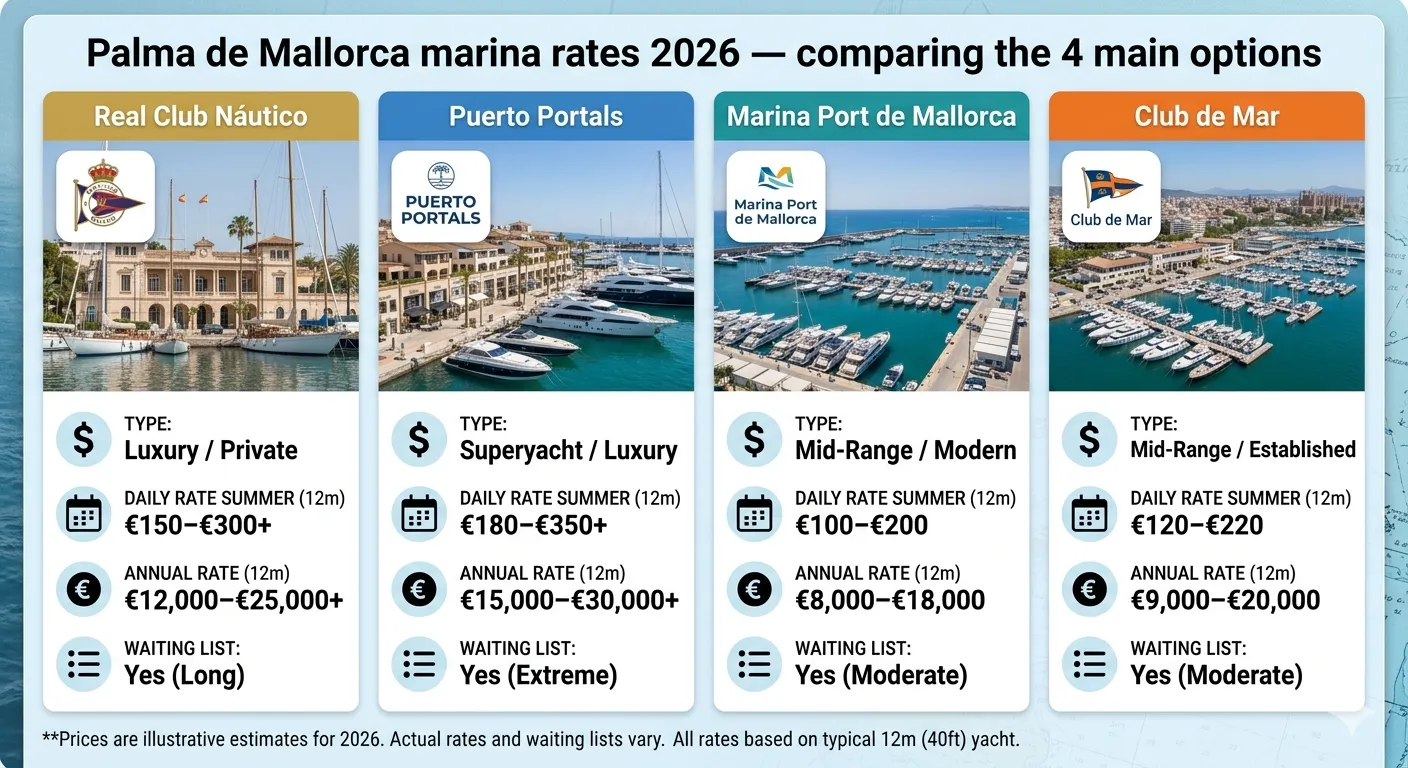
Comparing the four main marinas in Palma de Mallorca — from luxury private clubs to mid-range commercial facilities, all with waiting lists.
Palma de Mallorca has transformed into a major superyacht hub, with Real Club Nautico, Club de Mar, and Moll Vell as key marinas. The Real Club Nautico hosts vessels up to 90m. Palma is increasingly chosen as a base for owners wanting Mediterranean access with lower costs than the French Riviera.
At $110/ft/month, a 100ft yacht pays $11,000/month or $132,000/year in dockage alone. Shorter stays (transient rates) are typically 30–50% higher per day than monthly contracts. Most owners negotiate annual agreements for the best rates.
Fuel Costs in Palma
Marine diesel in Palma averages $7.0/gallon in 2026. A 100ft motor yacht consuming 65 gallons per hour runs approximately $455 per engine hour. At 200 annual engine hours plus generator and tender fuel, total annual fuel spend is approximately $104,649.
Tax & Registration: Palma
📋 Tax summary for Palma, Mallorca
EU VAT: 21% Spanish rate (Temp Admission applies). Consult a qualified marine tax advisor for your specific situation — tax treatment varies significantly based on vessel flag state, owner residency, and usage pattern.
Operating Season in Palma
Peak operating season: May–Oct. The Mediterranean commands the highest dockage rates globally — particularly Monaco and the French Riviera in peak season. EU VAT (20–25%) applies to vessels spending extended time in EU waters, though Temporary Admission allows non-EU owners to cruise for up to 18 months without triggering VAT. Charter rates are 20–40% higher than the Caribbean, making the Med the preferred region for charter programmes.
Calculate for Your Specific Yacht in Palma
The figures above are for a 100ft motor yacht. Enter your vessel's length and value to get an accurate annual estimate adjusted for Palma's local rates.
Open Calculator Pre-filled for Palma →Palma de Mallorca: The Mediterranean's Most Competitive Superyacht Market
Palma de Mallorca offers the highest density of superyacht-capable facilities in the western Mediterranean — 15,000+ berths across the island with approximately 3,000 in Palma's Bay alone. Competition between facilities keeps prices relatively competitive: Club de Mar accommodates vessels up to 135m LOA; Real Club Náutico handles up to 60m; D-Marin Palma Cuarentena offers berths up to 70m; Pantalán del Mediterráneo handles 20–120m; and Port Adriano (10km west, Philippe Starck-designed) accommodates up to 80m. For a 100ft / 30.5m motor yacht, Palma dockage in high season runs €3,500–€7,000/month, with premium marinas like Palma's premium berths reaching €400–€700/day during July–August.
| Marina | Character | Max LOA | Key Details |
|---|---|---|---|
| Club de Mar | West end of Paseo Marítimo; 575+ berths; discreet; celebrity-popular | 135m (waiting dock to 350m) | Adjacent to Astilleros de Mallorca refit yard |
| Real Club Náutico | 971 moorings; historic club; Copa del Rey Regatta host | Up to 60m LOA | Pools, spa, restaurant, gym |
| D-Marin Palma Cuarentena | Central Palma, 24/7 security; boatyard adjacent; STP access | Up to 70m LOA | Concierge; excellent for year-round owners |
| Pantalán del Mediterráneo | Central Paseo Marítimo; 60 berths for 20–120m LOA | Up to 120m LOA | Premium central-Palma address |
| Port Adriano (10km west) | Philippe Starck design; 482 berths; deep water; luxury restaurants | Up to 80m LOA | Balearics' most architecturally distinctive marina |
Copa del Rey Regatta: August's Signature Event
The Copa del Rey de Vela, held at the Real Club Náutico de Palma each August, is the premier sailing race in the western Mediterranean and one of the most prestigious offshore regattas in Europe. The regatta draws 120+ racing yachts and thousands of spectator visitors, filling Palma's marinas and anchorages beyond normal capacity. Marina rates during Copa del Rey week typically run 2–3× standard August rates; berths in prime positions sell out months in advance.
The Copa del Rey has the unusual distinction of drawing Spanish royalty as regular participants — King Juan Carlos I raced here for decades, and the royal family's presence elevates the event's social prestige beyond a typical yacht race. For owners who want to entertain charter guests during a world-class sailing event in a Mediterranean setting, Copa del Rey week provides the backdrop.
Mallorca's Year-Round Yacht Industry: The Palma Boat Show
The Palma International Boat Show (PIBF), held in April at the Moll Vell and Palma Marina, is the first major Mediterranean show of the year and one of the most important for superyacht sales and charter in the western basin. Approximately 200 vessels display at the show, with a focus on quality over quantity — sales transactions at PIBF regularly include the year's first significant charter bookings for the coming Mediterranean summer season.
Mallorca's Palma has also become the largest year-round superyacht industry base outside of Antibes and Fort Lauderdale. The STP (Superyacht Technology Park) shipyard complex in the port hosts multiple specialised refit businesses including painters, joiners, electronics integrators, and naval architects. Palma is now second only to Antibes in terms of year-round crew population — approximately 3,000–4,000 yacht crew are based on the island at any given time, drawn by the mild winters and quality of life.
Spain's Tax Framework and Mallorcan Considerations
Spain applies 21% IVA on marina fees and yacht services. The Balearic Islands are an autonomous community within Spain and apply Spanish national tax law, including IVA. Non-EU flagged yachts must complete EU import procedures or claim temporary admission (TA) for stays up to 18 months; TA for non-EU citizens is available under certain conditions but must be formally claimed at a Spanish customs port of entry.
Marine diesel in Palma in 2025–2026 averages €1.65–€1.90/litre — slightly cheaper than French ports due to Spain's lower fuel duty rates. The Balearic Islands government levies an eco-tax (Ecotax) on charter yacht passengers: €2/day per passenger in high season (2025 rate), charged to charter operators and passed through to clients. This must be collected, documented, and remitted by chartered vessels operating in Balearic waters.
Palma as the Mediterranean's Best-Value Refit Hub
Palma de Mallorca has emerged over the past 15 years as the Mediterranean's most competitive location for yacht refit and maintenance work — a position it has earned through a combination of modern facilities, skilled labour, moderate costs, and geographic convenience. For yacht owners evaluating where to base their vessel, Palma's refit economics deserve serious consideration as they directly reduce the single largest variable cost category in the annual budget.
STP (Servicios Técnicos Portuarios) is the centrepiece of Palma's refit industry. The facility can haul vessels up to 85 metres on its 820-tonne travel lift, and its covered sheds and hardstanding accommodate dozens of yachts simultaneously. Labour rates at STP-based contractors run €50–€80 per hour for skilled trades — painters, carpenters, engineers, electricians — roughly 35–45% below equivalent rates in Antibes or La Ciotat and 25–30% below Italian yards.
The savings on a typical annual refit cycle are meaningful. A standard winter programme for a 100ft motor yacht — bottom paint, hull polish, teak refinishing, engine service, generator overhaul, watermaker servicing, and interior deep clean — runs approximately €120,000–€250,000 in Palma versus €180,000–€400,000 for the same scope in Antibes. Over a 10-year ownership period, the cumulative saving can exceed €500,000 — a material factor in total cost of ownership.
Palma's refit industry is supported by a deep ecosystem of suppliers and specialists. Pinmar (now part of GYG), the world's largest yacht painting company, is headquartered in Palma. Rondal, Rolling Stock, Palma Yacht Crew, and dozens of independent contractors provide comprehensive coverage across all yacht disciplines. Parts sourcing benefits from daily freight connections to mainland Spain, Italy, France, Germany, and the UK, with most orders arriving within 2–3 business days.
Living and Operating on Mallorca: Beyond the Marina
Mallorca's appeal to yacht owners extends beyond the marina and refit yard. The island offers a quality of life that makes extended stays attractive for owners, crew, and guests — a factor that directly affects crew retention, which in turn affects operating costs. Yacht management companies consistently report that crew assigned to Palma-based yachts have 20–30% longer average tenure than crew on yachts based in less desirable locations.
The cost of living for crew on Mallorca is moderate by Western European standards. Shared accommodation in Palma runs €500–€800 per person per month — significantly less than the Côte d'Azur (€800–€1,500) and comparable to the lower end of Fort Lauderdale pricing. Restaurants, groceries, and entertainment are 20–30% cheaper than mainland France, and the island's beach culture, hiking trails, and nightlife provide off-duty recreation that crew genuinely enjoy. Happy crew stay longer, perform better, and cost less in recruitment and training cycles.
For owners spending time on the island, Mallorca offers international-standard infrastructure: a modern airport with direct flights to 150+ destinations (including year-round connections to London, Frankfurt, Paris, and Madrid), international schools (Baleares International College, Bellver International College), private healthcare (Clínica Rotger, Hospital Quirónsalud), and a well-established expatriate community. Many yacht owners maintain a Mallorcan apartment or villa as a shore base, treating the yacht as a floating extension of their island home.
The island's cruising grounds are excellent and underappreciated compared to the Cyclades or the Côte d'Azur. The northeast coast (Pollença, Alcúdia, Cala Ratjada) offers dramatic cliff anchorages, the southwest (Andratx, Deià, Sóller) combines mountain scenery with protected bays, and the Cabrera Archipelago National Park — 10 nautical miles south of Palma — provides a pristine marine reserve with limited-permit anchorage. A 100ft yacht can explore Mallorca's entire 340-mile coastline in 10–14 days of leisurely cruising, making it an ideal base for owners who want variety without long passages.
How Palma Compares
Compared to other major yacht bases, Palma sits in the Mediterranean region at $110/ft/month dockage and $7.0/gal diesel. Caribbean destinations like Nassau or Tortola are cheaper (dockage from $28/ft/month, diesel ~$5.50/gal), while French Riviera ports like Antibes cost significantly more ($140–$350/ft/month, diesel €6.50–€7.50/litre). See our full Mediterranean vs Caribbean cost comparison.